
'Agreements signed between the Maldives and China have seriously worried India.'

Abdulla Yameen Abdul Gayoom was today sworn in as the 6th President of the Maldives, ending nearly two years of political turmoil that threatened to isolate the country internationally.

Prime Minister Modi will be conferred with the Maldives' highest honour "Rule of Nishan Izzuddeen".
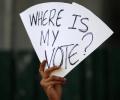
Democracy in Maldives is at the crossroads. There is need for the international community to put pressure on the incumbent regime in the country, so that it is not able to disrupt elections once again, and the democracy in Maldives could be saved from sinking, says Anand Kumar.

Anti-Corruption Commission rules out graft.

Would it serve India's interest to go to war with China over the Maldives, asks Aditi Phadnis.

'If all goes well, Modi will visit the Maldives later this year. But two Indian concerns remain unaddressed: President Yameen's intentions about Mohammad Nasheed and China,' says Rajeev Sharma.

It is time the political leaderships in this country arrived at a common ground over issues of foreign and security policy concerns. There has to be a greater communication between the government and the Opposition leaderships for the nation to present a unified face against the rest of the world, advises N Sathiya Moorthy.
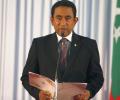
'Of course, Maldives is chicken feed for the Indian armed forces. And an intervention in the Maldives may serve the purpose of creating jingoism in an election year.' 'But from the foreign policy perspective, any such move will be a flagrant violation of international law and the UN Charter,' warns Ambassador M K Bhadrakumar.

'Without doubt, General Bajwa has deliberately snubbed India.' 'But why did he do that?' 'The Male leadership is simply fed up with Indian interference,' says Ambassador M K Bhadrakumar.
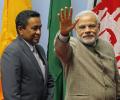
'Now is the time for India, our biggest neighbour and oldest friend, to bring the full array of international policy instruments to bear.'
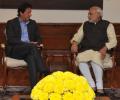
"The Prime Minister thanked the Prime Minister of Pakistan for his telephone call and greetings," MEA said.

In this exclusive conversation with Rediff.com contributor Rajeev Sharma, exiled opposition leader Ahmed Naseem explains why the world should care about democracy in Maldives.

Considered a powerful player in Maldivian politics, former President Maumoon Gayoom on Thursday sought to allay India's concerns over rise of fundamentalism in Maldives by assuring strict implementation of a law to check radicalisation of Islam once his party returns to power.

The action against the two journalists came as a privately-owned television station in the Maldives went off the air, citing threats during the country's current state of emergency.

Sri Lanka declared a state of emergency on Wednesday as angry protesters stormed the prime minister's office in Colombo, hours after president Gotabaya Rajapksa fled to the Maldives on a military jet, amid the country's worst economic crisis in decades.

Terrorism is not just a threat for a country but to the entire civilization, Modi said.

India's silence on this week's troubles in the Maldives is puzzling, says Rajeev Sharma.

Representatives of the Afghanistan government and Taliban militia are set to hold talks in the Maldives on national reconciliation, their second such meeting this year. "The government of Maldives confirms that talks are being held this week in the Maldives between Afghan lawmakers and representatives from groups opposed to the Afghan government," President Mohammaed Nasheed's press secretary Mohamed Zuhair said. The Maldivian government has no involvement in the talks.

Maldivian Vice President Ahmed Adeeb was on Thursday impeached by the Parliament overwhelmingly over an alleged attempt to assassinate President Abdulla Yameen and faces terrorism charges as lawmakers approved state of emergency in the island that has sparked concerns globally.
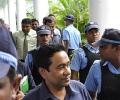
A delegation of the Progressive Party of Maldives led by its presidential candidate, Abdulla Yamin Abdul Gayoom called on Prime Minister Manmohan Singh on Friday.

'As of now, it may be best for India to insist that Yameen honours the supreme court rulings and ensures that the next election is free and fair,' says Brigadier S K Chatterji (retd).

At the Paris climate change summit, there is talk of restricting temperature rise to 1.5?C instead of 2?C, which has been negotiated so far. This would give India less space to grow by limiting carbon emissions further, reports Darryl D'Monte, reporting exclusively for Rediff.com from the French capital.
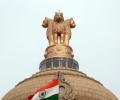
Delhi's inability to open up a new canvas with Pakistan and Sharif is symptomatic of its sluggish thinking. Jyoti Malhotra analyses

Infra major GMR is hopeful of maintaining strong order book.
